Man Wins Nobel Prize For Living As A Goat

A man lived like a goat in the Alps for three days. Researchers who dressed rats in woolly trousers to understand their sex lives. And scientists who investigated the personalities of rocks.

They shared a stage Thursday night, but they weren’t actors in the world’s weirdest pantomime.
Instead, they’re just some of the winners of the 2016 Ig Nobel Prize held at Harvard University.
“It’s like the weirdest f-ing thing that you’ll ever go to… it’s a collection of, like, actual Nobel Prize winners giving away prizes to real scientists for doing f’d-up things…it’s awesome,” Amanda Palmer, a performer and writer, was quoted as saying on the Ig Nobel website.
The spoof awards — which aren’t as famous as the real Nobels — are held annually and were inspired by the Annals of Improbable Research, an American science humor magazine that celebrates and honors the wackier inventions from the scientific community.
The main aim of the Ig Nobels is to make people “laugh, then think,” and incite the public’s interest in STEM, according to the Ig Nobel website.
Read More: CNN
American, Swede, Turk Share Nobel Prize For Chemistry

Three scientists from Sweden, the United States and Turkey won the 2015 Nobel Prize for Chemistry on Wednesday for working out how cells repair damaged DNA, providing new ammunition in the war on cancer.

Detailed understanding of DNA damage has helped drive a revolution in cancer treatment as researchers develop new drugs that target specific molecular pathways used by tumor cells to proliferate.

Tomas Lindahl, Paul Modrich and Aziz Sancar won the prize for “mechanistic studies of DNA repair.” Their work mapped how cells repair deoxyribonucleic acid (DNA) to prevent damaging errors from appearing in genetic information.

In many forms of cancer, one of more of these repair systems is broken.

“Their work has provided fundamental knowledge of how a living cell functions and is, for instance, used for the development of new cancer treatments,” the Royal Swedish Academy of Sciences said.

Read Moretribuneonlineng

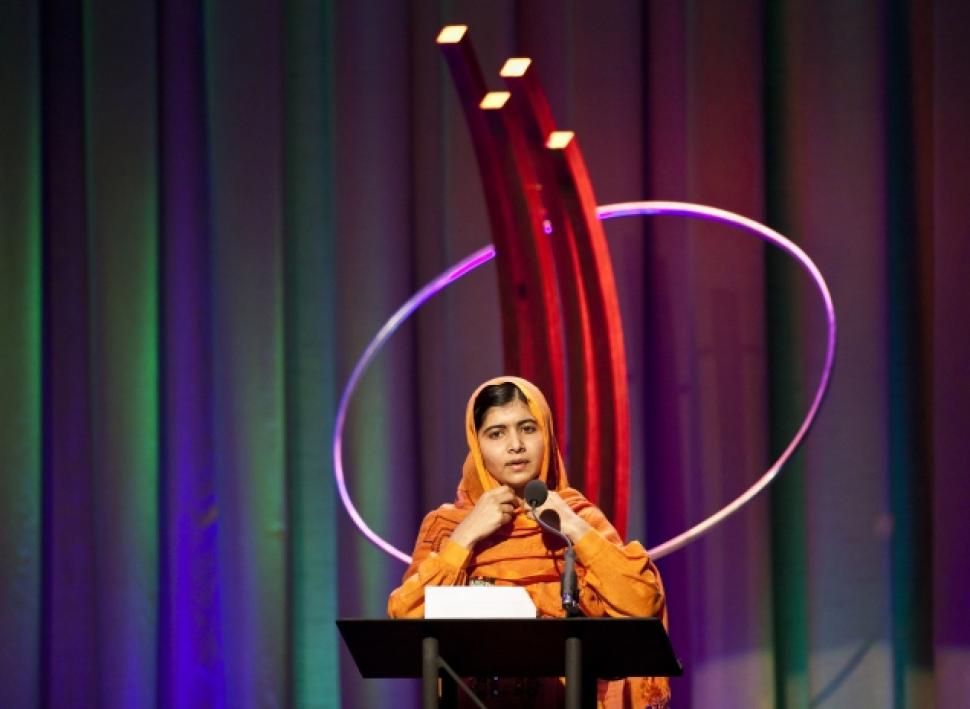
Malala Feels “More Powerful and Courageous”

After becoming the youngest person to win the Nobel Peace Prize, Malala Yousafzai urged children to “stand up for their rights”.

Malala dedicating the award to “all those children who are voiceless”, she said: “My message to children around the world is; stand up for your rights and that she was “honoured” to receive the award, saying it made her feel “more powerful and courageous”.

She also said she was “really happy to be sharing this award with a person from India”, before joking that she couldn’t pronounce Mr Satyarthi’s surname.

She said she and Mr Satyarthi had decided to invite Indian Prime Minister Narendra Modi and his Pakistani counterpart Nawaz Sharif to the award ceremony in December in Oslo in a bid to improve relations between the two.

She went further to thank her father for “not clipping her wings” and said she was proud to have shown that “a girl is not supposed to be a slave”.

She will receive a medal and $1.4m (£860,000) pounds in prize money.

Speaking at a news conference in Birmingham, UK, where she now lives, she revealed she found out the news after being called out of her chemistry class at school. Despite her excitement, she said she attended her afternoon lessons in physics and English.

Malala Wins Nobel Peace Prize

181564487rt050-cgi2

Pakistani child education activist Malala Yousafzai and Indian child rights activist Kailash Satyarthi have won the Nobel Peace Prize.

At 17, Malala is the youngest recipient of the prize.

The teenager was shot in the head by Taliban gunmen in October 2012 for campaigning for girls’ education.

The Nobel committee said the pair were awarded the prize “for their struggle against the suppression of children and young people”.

Mr Satyarthi, 60, has maintained the tradition of Mahatma Gandhi and headed various forms of peaceful protests, “focusing on the grave exploitation of children for financial gain,” the committee said.

This year’s record number of 278 nominees included Pope Francis and Congolese gynaecologist Denis Mukwege, although the full list was kept a secret.