Fear Grips FCT Suburbs Over Fresh Demolition

Tasha 1/One Man Village Landlord Association and Residents of Gwagwa, a suburb in the Federal Capital Territory (FCT), under Abuja Municipal Area Council (AMAC), has raised alarm over alleged ‘selective demolition’ plan of their houses by Federal Capital Development Authority (FCDA).

According to eyewitness, Clara Williams said, “I heard of the demolition plan from the workers doing some renovation work in my apartment that they were asked to stop work and that they are coming for demolition.

“Immediately, I called Aliyu (the guy that sold the land to me), and he confirmed that the lands had been sold to an estate developer” Williams said.

 She further stated that they got a news that Hakimi (District Head), and his cabinet members were coming to brief residents on the alleged demolition plan, “so most of us stayed back and did not go work, after several hours of waiting. Hakimi showed up in the company of his secretary, one Zakare, and a guy who claimed to be a staff of FCDA, we thought they came to address us, but instead, they were busy pointing where the exercise will start from.”

Creditdailytimes

Nigerian Refugees Who Fled Boko Haram Still Fear Returning Home

Fanta Adamu thinks she’s more than 80 years old but isn’t sure. What she does know is she couldn’t have escaped without help when Boko Haram threatened to overrun her village in northeast Nigeria.

As the fighting intensified in Sabon Gari, in the far north of Adamawa state, she called one of her sons, who came the 1,200 kilometres from Lagos to get her out.

She was brought to a three-room rented house on the fringes of the state capital, Yola, which she now shares with 19 other family members.

“I’m expecting to go back soon but the problem is the roads. Boko Haram has vandalised everything,” she told AFP on Thursday.

Also read: Boko Haram refugees suffer “dramatic” conditions

“I’m expecting everything to be bombed. We are afraid to go back.”

Fanta and her family’s situation is far from unusual in Yola, which as a relative safe haven saw its population more than double with those fleeing Boko Haram violence in northern Adamawa and the neighbouring states of Borno and Yobe.

The media focus in recent days may have been on the internally displaced people’s (IDP) camps around Yola, to which 275 women and children hostages were taken after being freed by the military from the militants’ Sambisa Forest stronghold.

But many more refugees are staying in temporary accommodation in and around the city, with thousands bunking down for months with host families or relatives in often heavily overcrowded homes.

Uncertain future

Haruna Hamman Furo, permanent secretary of the Adamawa State Emergency Management Agency (ADSEMA), said that at its peak at the turn of the year, there were about 30,000 IDPs in camps in Yola and some 142,000 in host families.

But others say as many as 400,000 flocked to the city, particularly after Mubi, some 200 kilometres (125 miles) to the north, fell to the extremists in early November.

Since Nigeria’s military began a concerted fight-back against the Islamists with the help of Chad, Niger and Cameroon in February, the numbers have gone down, said Furo.

Overall, some 1.5 million people have been left homeless by the violence since the insurgency began six years ago.

Most have remained in Nigeria, although others have fled to neighbouring Cameroon, Chad and Niger. All are putting an additional strain on local resources.

Fanta and her family receive help from the Nigerian Red Cross, which distributes foodstuffs such as rice, cooking oil and salt as well as mats and mosquito nets.

Church groups, mosques, the state government and the American University of Nigeria (AUN) distribute food and clothing to those who fled with nothing.

The AUN, which is based in Yola, said earlier this year it was feeding some 250,000 people and talks of a prolonged humanitarian crisis.

In the meantime, the men in Fanta’s family are looking for work in Yola while some of the children go to school.

Despite the semblance of normality, they yearn to go home.

“You can’t compare living in a different place in a part of the world that you don’t know,” said Aishatu Ado, 35. “We are not enjoying it.

“Even if we go back, we don’t know the situation because the farms have been destroyed. We are just waiting to see what will happen.”

Living in hope

Zainab Ali washes trousers and pink school tunics in a black bucket, wringing out the water and hanging them on the line to dry in the scorching midday sun.

Strapped to her back as she bends and stretches is eight-month-old Karima.

All the displaced have a story to tell of their frantic escape. Ali, 37, is no different.

“I suffered a lot because running from Madagali to here wasn’t easy. Some of my friends gave birth on the way,” she said.

“We trekked for one day before finding a car to bring us to Yola. Four or five of us were pregnant.”

Karima was born in the rented house, where chickens running loose in the yard are shooed off mats on which the women and young children sit under the shade of straw thatch.

With Boko Haram pushed out of captured territory, there is increasing talk of more displaced people leaving camps in Yola and across the north and finally going home.

Ali is confident that day will come soon, with Nigeria’s incoming president Muhammadu Buhari, a former military ruler, due to be sworn in on May 29.

“From what we have seen, things will change. He’s a soldier and since he’s won the election the violence has come down,” she said.

Credit: AFP

Boko Haram: Weapon of Psychological Fear- Dinah Adams

Boko-Haram-2

Videos of horrid activities executed by insane horrid terrorists are allowed on public media channels, which is primarily an ignorant way of lending a helping hand to the terrorists.

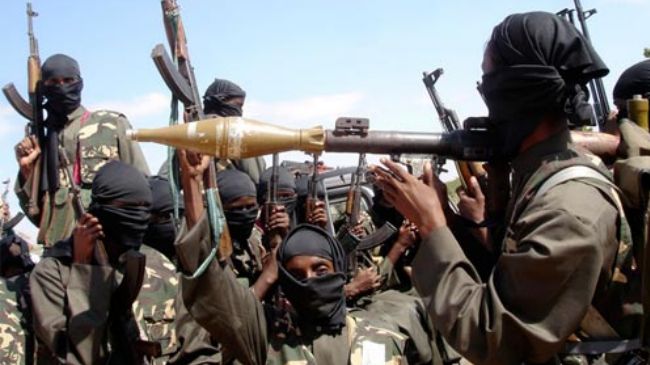
Most of us are unaware of the most valuable weapon employed by these terrorist before they even engage in any physical attack or battle. Aside their rifles, explosive tanks, bombs, rocket propellers or whatever they use to rain down terror on normal people, these people instill fear into the minds of people before they strike.

The doctrine of instilling psychological fear into the victim has been used by warlords since the inception of war and conflict. They understand that fear, when accommodated can breakdown the enemy prior to confrontation. Hence, they most times exhibit an array of their “game” like hunters would, to prove to the enemy that they are capable of destruction, not just by mere words.

History provides ancient warlords who have a collection of human heads as a count regulator for their victories and most times provides them with titles like “Slayer of Kings”.

boko1

Today digital media provides a hi-tech platform for these gruesome exhibitions with so much ease. Al Qaeda, Al Shabaab, ISIS, Boko Haram, aside many other terrorists networks have enjoyed the privileges of free broadcasting on virtually or almost every international media outlet, and of course not forgetting YouTube. These offensive videos somehow gets to be seen by most visual media audience and then it goes viral within splits of seconds.

It is quite disturbing that most people will intentionally miss a presidential broadcast but will go searching for a terrifying video clip recorded by terrorists. Truth is, viewing these videos is a step closer to the terrorists or death itself. In other words, the content was created to condition people’s minds into accepting the unexpected, while not viewing them frees your mind from the unexpected.

“What you do not know cannot kill you” might lamely express the intention of this content but illuminates the surface truths of it. Another statement provides that “Pictures tell a thousand words”. It is therefore wise to know what you need to know, in order not to be ignorant of unfolding events around you; but then it is wiser to avoid viewing still or motion images that can deteriorate the condition of a common mind that already exists in a state of insecurity.

Regulating the flow of these visual content might be impossible but refusing to patronize them is possible and also an individual effort to defeat the intended fear created for distribution. Viewing  video clips of humans beheading humans or very gruesome and unimaginable methods of murder does educate your underestimation of the enemy but terrifyingly petrifies you and prepares you into accepting defeat.

It is true that Boko Haram has executed several victorious attacks against this nation, which they have flaunted, but they will not and never show you the ones they attempted and failed woefully. This is because they employ the “instill fear and conquer” philosophy and cannot afford to allow Nigerians to see their many weak points.

Finally, amidst the seemingly disappointing efforts of the Nigerian Army, it is however sad that we mostly get to see more of their failures than their victories. Also have in mind that the Nigerian Army was once the military strength of Africa and the backbone of ECOMOG. Let us not lose heart but rather resurrect our hopes into believing that this same Army that halted many civil wars can end this;  but most importantly, overcome the weapon of psychological fear by defeating the urge to patronize it.

Dinah Adams @didiyargata