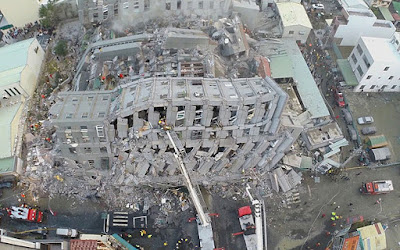
The death toll from a powerful earthquake in central Italy rose to 247 on Thursday amid fears many more corpses would be found in the rubble of devastated mountain villages.
Rescuers sifted through collapsed masonry in the search for survivors, but their grim mission was clouded by uncertainty about exactly how many people had been staying in communities closest to the epicentre of Wednesday’s quake.
Hundreds of people spent the night sleeping in their cars, in hastily-assembled tents or as guests of families in nearby areas less affected by the quake.
Monica, a survivor from the tourist town of Amatrice, told of her numbed response when a 4.5-magnitude aftershock rattled the area just after 5.00 a.m. (0300 GMT).
“We are sleeping in the car and there were shocks all night. When the biggest one came, the car started moving and shaking.
“But what have we got to lose now? We have lost our house. So many friends and family are dead. We have lost everything, even our fear,” she told AGI news agency.
– Ghost villages –
The damage to smaller, more remote hamlets has left their very existence in doubt in an area that has suffered decades of depopulation and already has numerous “ghost” villages.
“If we don’t get help, l’Arquata is finished,” said Aleandro Petrucci, the mayor of Arquata del Tronto, which accounted for 57 of the confirmed deaths to date.
Petrucci said it was impossible to say exactly how many people were in the 13 hamlets comprising his community when the disaster struck.
“Here in the winter, the village is practically uninhabited but the population doubles or triples when people come back to their family houses in the summer,” he said.
In Pescara del Tronto, which was virtually razed by the quake, there only four permanently resident families.
But Petrucci said there could have been up to 300 people there on Wednesday.
Some may have fled back to Rome, the mayor said, appealing for them to get in touch. “Otherwise we could be trying to dig out ruins where there is no-one,” he said.
– Rebuild and start again –
Measuring 6.0-6.2 magnitude, the quake’s epicentre was near the towns of Accumoli and Amatrice, occurring at the shallow depth of four kilometres (2.5 miles), according to monitors.
But it was only the latest in a long string of killer quakes in the central Apennines, part of the mountainous “spine” that runs down Italy. Records dating back seven centuries attest to tens of thousands of deaths.
The Civil Protection agency which is coordinating the rescue effort said that in addition to the dead, 264 people had suffered injuries serious enough to be hospitalised. Several of them are in a critical state.
Although firemen and volunteers on the ground were pessimistic about the chance of finding any more survivors, several of them recalled that the last survivor of a 2009 in nearby L’Aquila was pulled from the rubble some 72 hours after it struck.
“The operation continued throughout the night and obviously there will be no let-up until it is absolutely clear that there is no possibility of finding any more people in the ruins,” said Immacolata Postiglione, the head of the Civil Protection agency’s emergency unit.
Prime Minister Matteo Renzi was chairing an emergency cabinet meeting which he said would put in place the first plans for reconstruction.
“The objective is to rebuild and start again,” he said.
An inquest was also underway into how such a thinly-populated area could have suffered such heavy casualties, given the lessons of recent history.
Seven years ago, the L’Aquila disaster, in which 300 people died, exposed how ill-equipped many of Italy’s centuries-old buildings are to cope with an earthquake.
– 13th-century tower intact –
“As geologists we have been saying for years that we are very far away in Italy from having a culture of prevention,” said Francesco Peduto, president of the Council of Italian Geologists.
After the L’Aquila quake, the Civil Protection agency made almost a billion euros available for upgrading buildings in seismically-vulnerable areas.
But the take-up of grants has been low, largely because of the cumbersome application process, according to critics.
One building which was supposed to have been quake-proofed was the Romolo Capranica school in Amatrice, which completely collapsed on Wednesday just four years after a 700,000-euro upgrade.
That was in sharp contrast to the oldest building in the town, the 13th-century Civic Tower, which was still standing Thursday, despite having been shaken sufficiently to detach its bell from its fastenings.