Why President Trump using an unsecured Android would be a very bad idea – By Daniel Howley

The president of the United States is protected by a cavalcade of secret service agents at all times, uses a secure landline in the Oval Office and rides around in a limo that can survive a chemical attack. But it seems like Trump is skimping on security where it might matter most: his smartphone.

According to a report by The New York Times, Trump is still using an unsecured Android smartphone, rather than the kind of secure device President Barack Obama begrudgingly used after giving up his locked-down BlackBerry last year.

Why does it matter that Trump might be using an unsecured smartphone? Because gaining access to the president’s handset could give attackers a means to view anything he has saved on the device. Heck, hackers could enable the phone’s microphone without anyone ever knowing, giving them the ability to listen in on private conversations.

“Nearly all smartphones have location services as well as microphones,” explained security researcher and journalist Ashkan Soltani. “An attacker could use this device to track the president’s movements, even if it were not his primary phone, or hot-mic [remotely enable the phone’s microphone] to monitor his private conversations — another matter of national security.”

It’s also worth pointing out that Trump’s Twitter account, which he might access through his phone, has changed the direction of stocks in just 140 characters. If someone gained access to that account, they could send the stock market into free fall or cause a national panic.

“We live in a time when policy decisions and reactions happen in an instant,” Soltani said. “Were a foreign actor to hack his device, or otherwise get a hold of that account and tweet something at another nation state, that could inadvertently cause a diplomatic crisis or even a war.”

To be sure, it’s not clear that Trump is the person using this unsecured phone or if he has a staffer use it. It’s also unclear if the phone does anything beyond simply allow for Twitter access, or if it’s a fully functional phone.

Either way, the security of the president’s smartphone is incredibly important. When Obama traded in his BlackBerry, the smartphone he received from his security experts was essentially a tiny black brick.

Obama said his phone couldn’t do basic things like send text messages, take pictures or even play music. But as far as we know it was secure enough to prevent a hacker from attacking it.

Interestingly, as AndroidCentral points out, The New York Times’ report seems to contradict a previous Times article, which stated that Trump did in fact turn in his old Android phone for a secure device provided by the Secret Service.

We’ve reached out to the White House for comment and will update our piece when we receive a response.
WhatsApp on a major takeover, launches video calling for everyone.

WhatsApp wants to be international cross-platform FaceTime. Today Facebook-owned chat service WhatsApp is officially launching video calling for its over 1 billion users worldwide on iOS, Android and Windows Phone. Its debut follows a series of reports from people who recently found the feature had been enabled in beta versions of WhatsApp on Android and on Windows Phone – an indication that a public debut was on the near horizon.


To use the new feature, WhatsApp users can hit the call button in the top right corner of a conversation, which will bring up an overlaid interstitial asking if you want to voice or video call the friend or family member you’re chatting with. To kick off the video call, you simply select the “video call” option from this screen.


During the call itself, you can switch between the forward-facing and rear camera, mute the call or press the red button to hang up. It seems the user interface varies slightly on Android and iPhone in terms of where the picture-in-picture video feed is displayed, as well as the buttons’ size, lineup and placement. (See images and video below).


WhatsApp already supports a number of standard features for communications apps, including group texting and voice calling. But the company says that video calling has remained one of its top feature requests from users.


With video calling, WhatsApp is belatedly catching up with a number of rivals, including Facebook’s own Messenger app, for example, as well as Skype, Apple’s FaceTime, Viber, LINE and Google’s recently launched Duo, to name a few.


Though a late entrant, WhatsApp still has a massive user base and the addition of the feature could help them from fleeing to other messaging and calling platforms. In addition, WhatsApp touts its cross-platform support as one of the reasons to use video calling in its app, instead of elsewhere.


“…we want to make these features available to everyone, not just those who can afford the most expensive new phones or live in countries with the best cellular networks,” the company said in its announcement, published today.


That’s a direct shot at things like FaceTime, which only works on Apple devices, as well as newer arrivals, like Google Duo, which only runs on later versions of iOS and Android (Jelly Bean and up, or iOS 9 and up).


You may not immediately see video calling in WhatsApp today, however. The rollout is staged, meaning it will arrive over the days ahead as it reaches the entire WhatsApp user base.


Video calling isn’t the only new addition to arrive recently. The company also rolled out two-factor authentication in some of its beta versions, hinting that its next big release could be a security-focused upgrade.


By retaining its simple interface but embracing more vivid connections beyond texting, WhatsApp could flourish with users no matter how they want to communicate.

BlackBerry To Stop Production Of Phones

Canadian company shifts focus to software having struggled to compete as mobile users opt for touchscreens

 
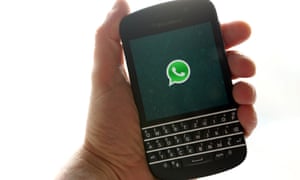
WhatsApp in use on a BlackBerry phone
 WhatsApp in use on a BlackBerry phone. Photograph: Adam Berry/Getty Images

BlackBerry is shutting down its phone business after 14 years of making handsets.

The company’s devices were once the phone of choice for professionals, providing access to emails on the move, but BlackBerry has struggled to keep up with competition from rivals Apple and Samsung as mobile users increasingly opt for touchscreens.

The Canadian company is now focusing on making software and will outsource the manufacture of hardware to other companies.

John Chen, the company’s executive chairman and chief executive, said: “We are focusing on software development, including security and applications. The company plans to end all internal hardware development and will outsource that function to partners. This allows us to reduce capital requirements and enhance return on invested capital.”

Chen said earlier this year that he would know by September whether the loss-making handset business was likely to become profitable.

John Jackson, analyst at IDC, said BlackBerry’s decision to stop making devices was “entirely sensible and probably overdue”. He added: “Software revenue and the margin profile associated with that is where the focus should have been, and now can be.” 

CMC Markets said the death of the BlackBerry handset marked the end of an era for a company once considered one of the world’s major smartphone vendors. CMC said that at its peak in September 2013, there were 85 million BlackBerry subscribers worldwide, but by March 2016 the number had fallen to 23 million as it lost out to the Android and iOS platforms.    

Colin Cieszynski, chief market analyst at CMC, said: “Today marks a big transition for BlackBerry and the end of an era for the company. The company plans to shift its focus fully to communications and security software development, reducing capital requirements and increasing margins.”

BlackBerry shares rose in pre-market trading after it announced better-than-expected earnings for the second quarter and revised up earnings expectations for the full year to a range of zero to five cents a share, compared with current market expectations of a 15-cent loss.

Cieszynski said traders were shrugging off a shortfall in revenues, which were lower than expected at $352m. “Traders have decided to focus on the 89% revenue growth over the year in their software services business,” he said.

BlackBerry also announced that its chief financial officer, James Yersh, was leaving the company at the end of October for personal reasons. He will be replaced by Steven Capelli, the former Sybase executive.

Yoruba Keyboard Language Pack Is Now Available For Mac And Windows Users

Now this is handy.

The geniuses at Yorubaname.com have come up with a nifty little language tweak for Mac and Windows users. Users can now include tone marks and subdots in their names and sentences by installing a Yoruba keyboard language pack.

There are other solutions out there, especially on Windows, that make writing in yoru?ba? (see that?) a possibility but the team claim their language pack offers both layouts with very similar key combinations for consistency.

If you remember, this is the same team that brought us Twitter in yoruba. Or at least were partly responsible. Seems they have no intention of slowing down.

Source – Techcabal.com